
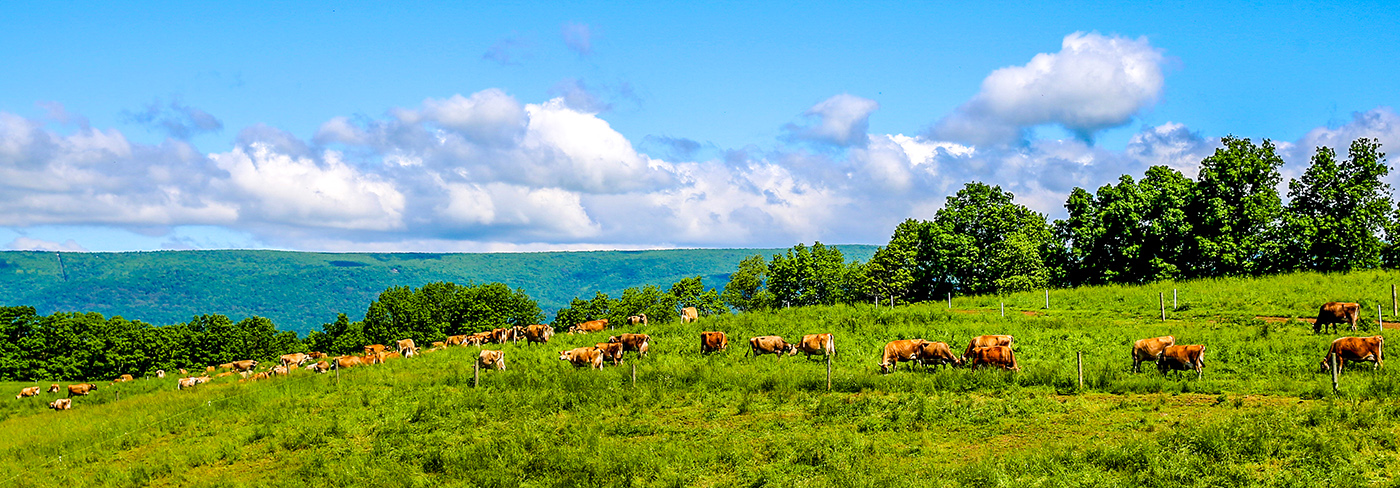

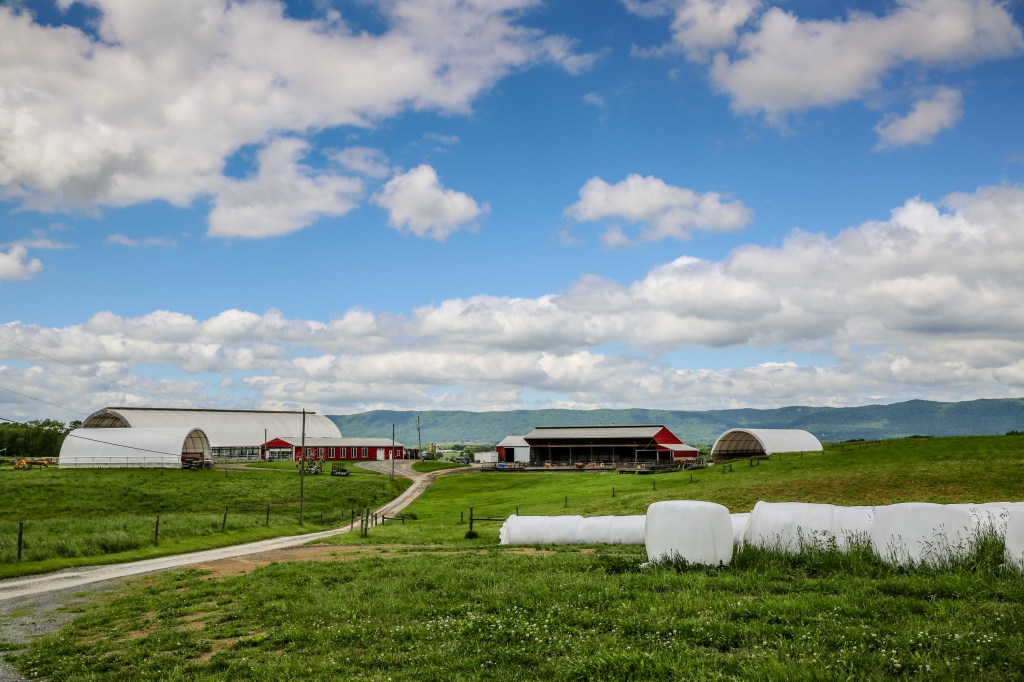
CHAMBERSBURG, Pa. — Few things make the growing Martin family happier than working together with Jersey cattle and seeing those cows on green grass. Spread over rolling hills against the Broad Mountain backdrop are 700 acres of grazing, hay ground, and forage crops feed 350 registered Jersey milk cows, plus dry cows, and replacements at Pleasant Valley Jerseys, LLC.
The farm operates like a New Zealand style seasonal, intensive, rotational grazing dairy.
When the hoop barn and double-24 swing parlor were built in 2017, the former partnership became an LLC with Doug and Julie Martin and their son Grant Martin and daughter Jill Wiser as members. On July 1, 2023, Grant’s wife Kim and Jill’s husband Josh became LLC members too. Doug and Julie’s oldest daughter, Amy Coblentz, husband Philip and three daughters farm with his family in Middletown, Maryland.
The PVJ operation is owned and operated today by the third and fourth generations, with the fifth generation accompanying parents and grandparents, who do all of the daily work, without fulltime hired help.
A typical morning finds Doug, Julie, Grant, Josh and Jill in the milking center.
“Mom helps with prepping and dipping until she goes to feed the calves. Dad comes in to look at the cows and scrape the barn. Josh and I milk, and Kim likes coming in to milk in the afternoons,” Jill explains.
Julie is the main calf feeder and bookkeeper. Josh and Jill share herd managing duties and work with Doug on the genetics as well.
“Grant does the crops, feeding and fixing, and he stops into the parlor in the morning to chat amd help milk for a little. That’s when we hash things out, during milking, and lay out the plan for the day of who is doing what, when and where,” says Jill.

This high component herd had a 305-day ME of 14,092m 5.7f 3.33p on test May 13. Nearly 30 years ago, they were among the first herds in the Northeast to be paid for protein pounds before it was part of the federal order formula.
“We have always bred for butterfat. Even though we hear it said to focus on protein and volume, we do have a butterfat focus,” says Doug about their components-driving breeding philosophy.
He discovered early-on that while butterfat genetics tend to bring protein along, a pure protein and volume focus doesn’t give them the butterfat they want to see. Their aim is to market components, not volume, and butterfat is paying the bills right now at $3.33/lb vs. protein at $0.83/lb.
Their milk goes primarily to make cream cheese or butter.
The shift to grazing was started in 1993, but even before that, Doug was interested in New Zealand genetics because that market has always been component-driven.
He also liked what he saw in New Zealand cows. He’s been there four times and has picked out bulls to breed to his favorite cows, then picks sons to put on the rest of the herd from the 25 to 30 bulls raised at Pleasant Valley Jerseys (PVJ) each year.
They keep some, sell some, and occasionally collect one. They are sold out of bulls for the season after the big demand this spring, all by word of mouth, with repeat customers that have been buying PVJ bulls for 10 to 15 years.
They’ve also sold female dairy replacements and project calves this way, marketing an estimated 1000 head of breeding stock off the farm in the last 20 years, usually in groups of 40 to 60, in addition to the bulls.
Choosing herd bulls brings a bit of friendly competition, that is really more rooted in curiosity.
“When it comes to breeding the heifers, Dad, Josh and I will compare notes and pick which bulls we like and want to use, and if we can’t all agree, we’ll each pick one or two, put them out with the heifers, and see which ones breed better,” Jill explains.
They use DNA testing to line up parentage and see who performed best. “It’s fun getting the information back and finding out the results.”
How do they make mating decisions on their AI-bred cows?
“Josh picks, I pick, and Dad picks,” says Jill. “Dad writes down what he thinks, and Josh and I write down what we think. Then we compare notes and decide together who we’ll use.”
“We’ll look at genomics too for components and somatic cell count and to check haplotypes and A2,” Doug explains.
“We’ll use a little bit of the type bulls if we like the cow family,” Josh relates.
Doug agrees: “Cow families are most important. Longevity is what we look for,” and that covers a lot of other things.
The PVJ herd has 12 cows now completing seven or more lactations with over 100,000 pounds of lifetime milk. Their highest has 140,000 lifetime. Of the 347 milking today, 53 have more than five lactations.
Nearly one-quarter of the herd, 76 cows, are scored EX, with eight at 95 points and a herd average score of 87.6.
Of course, there are some ‘favorites.’
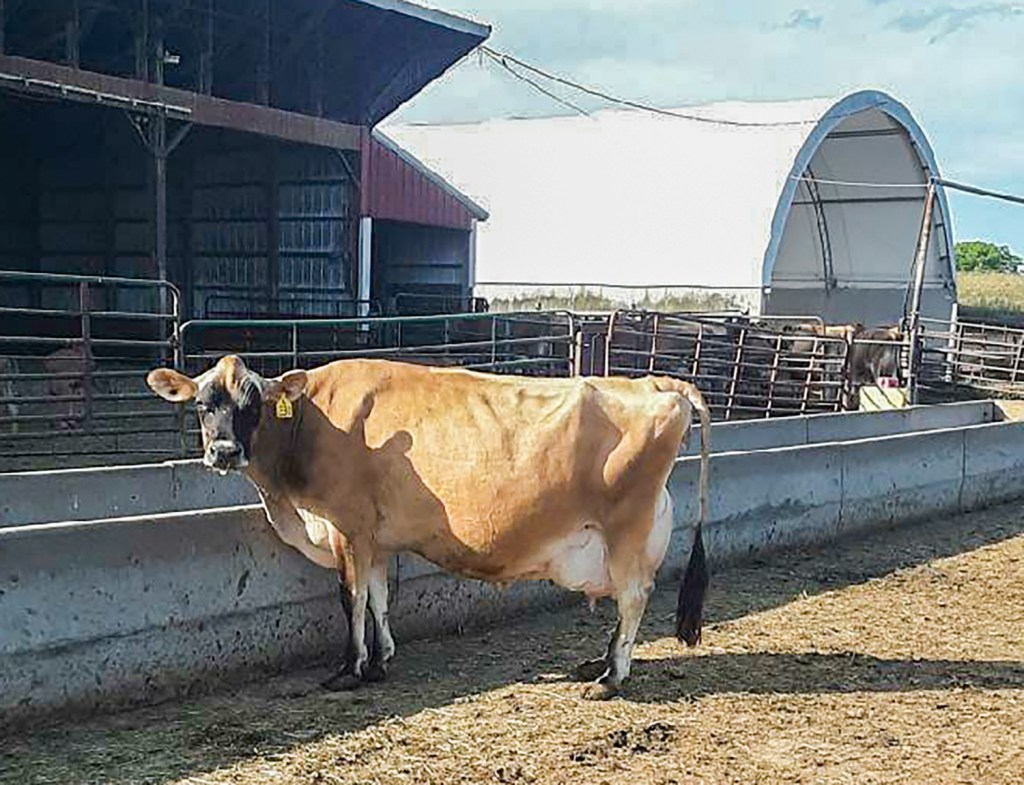
One is the 140,000-pound lifetime Hillacres Verb Shanell EX-95 (above). She is the oldest cow on the farm, with six natural daughters in the herd, and they’ve used two of her sons.
“At milking time, she’s first to the parlor,” says Jill. Her dad bought Shanell as a heifer, and she has done really well for their herd.
The best ‘show cow’ bred here is Pleasant Valley Prime Heather EX-96. The late Michael Heath had taken an interest in her and purchased her with Spring Valley Farm. Her most famous son was SV Jade Hired Gun at ABS St. Jacobs, and her picture adorns two spots on the wall in the office at Pleasant Valley.
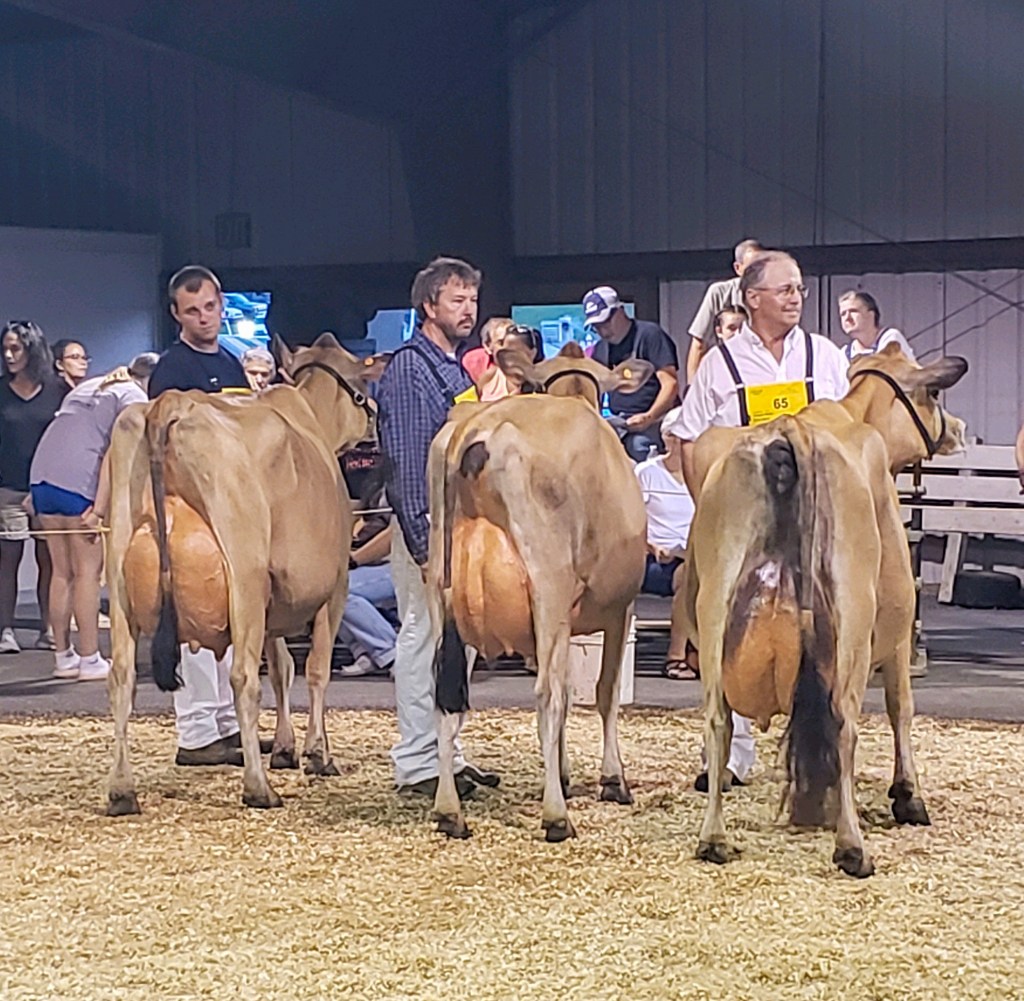
The Martin family shows each year at the District II Jersey Show during the Shippensburg Fair. In 2023, they had the grand champion Pleasant Valley Shelton Rosel, max-scored at EX-94. In 2015, they had grand champion with Pleasant Valley Kasper Cookie.
Pleasant Valley Landy EE Brenda EX-95 vies for a spot as another favorite, affectionately known as “pretty girl.” She is very ‘Jersey’ in her looks, her sire being the first New Zealand bull Doug purchased, which has so influenced the PVJ herd: Beledene Dukes Landy.
Doug was the one to transition the farm from Holsteins to Jerseys. The first Jersey he bought was Top-O-Hill Milestone Faithful in 1979. Her family includes one of their 95-point cows today, Pleasant Valley Vaden Faithful, now in her 10th lactation with over 120,000 pounds lifetime.
“This great Jersey community is huge,” says Doug, recalling the World Conference he and Julie attended more than 30 years ago in England. They met Queen Elizabeth and saw her Jersey herd and the Royal family’s personal creamery at Windsor Castle.
“We were the youngest couple in the group. The Queen came through and approached us and spoke to us. We learned she was using a New Zealand bull,” Doug recalls, noting that he had been looking at a bull from Malcom Revell that had come up for sale. He went in with an Ohio breeder to buy the bull.
“Landy, was the first New Zealand bull I bought, and here the Queen of England was using his brother Beledene Dukes Lord.”
Most generations in the PVJ herd today have some Landy in them.

As they shifted to grazing, New Zealand genetics continued to be a fit, and the Martins adopted seasonal calving to match milk production to the patterns of weather and the land.
In January and February, they milk 190, peaking in May at around 320, and again in the fall at 350. Spring calving is March and April, and as grass growth peaks at the end of May and beginning of June, those cows are being bred.
Fall calvers are dried-off in June ahead of August and September calving as grass growth again peaks with fall rains in October.
“We’ll milk 300 then until the end of the year and start drying off for January and February,” Jill explains.
The calving months can be long with so many fresh cows and parlor training fresh heifers, but the double-24 swing parlor makes all the difference compared with the double-10 at Doug and Julie’s home-place previously. At peak, they can milk in about three and a half hours, taking less than two hours in the down months.
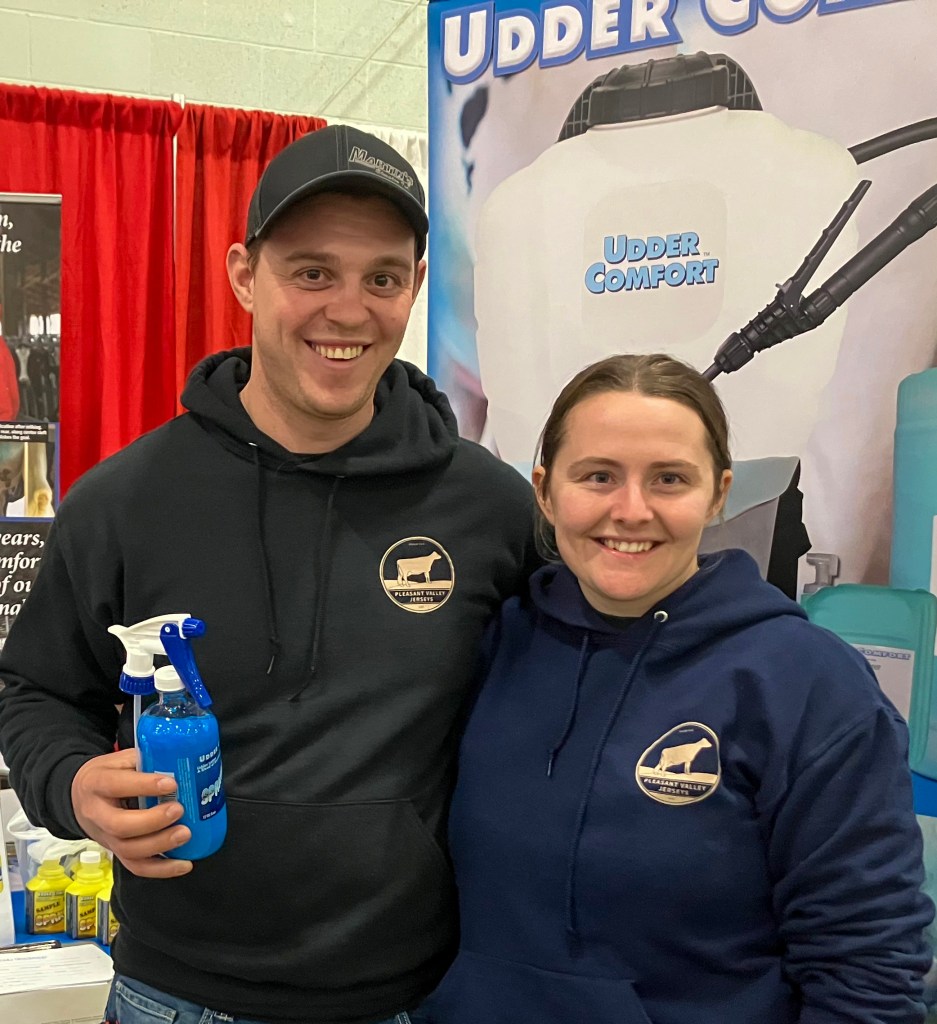
“We don’t do intramammary treatments in the milking period, but we do dry treat
a few, and we love Udder Comfort for fresh cows and heifers. It’s the only one
that works to get swelling down fast, making cows comfortable, so they do
better. We’ve used this product 15 years, spraying udders 2x/day for 5 days after
calving. That means doing large fresh groups in spring,” says Jill.
“This spring went so smooth with the Udder Comfort Battery-Operated Backpack Sprayer,” says Josh. “It really shortened the application time to do those large groups of fresh cows. We can have 30 cows done in under 5 minutes! That’s a blessing, especially at times when you’re shorthanded.”
The seasonal milking matches the intensive rotational grazing, which begins in April and ramps up by mid-month. The permanent perimeter fencing with some permanent interior fence is then paddock-sized using temporary polywire, set throughout the season by how much pasture growth and how many animals are in a group.
“One acre per 100 cows for 12 hours is our general rule of thumb,” says Grant.
“Flexibility is the key,” says Doug.
“Growth has been better this year; our first cuttings of baleage last year were half the yield,” says Grant. He took time on a sunny May morning for part of this interview anxious to get back to hay-in-a-day.
In spring, the cows get one-quarter of their feed from the bunk. Grant mixes just enough to get the pellet to them. Temperature and weather fluctuations affect this, and he judges the bunk.

“The baleage really works well to not have a big trench face open to invite nuisance bird activity,” notes Doug.
The barn is more for winter, and it’s where they come into the feedbunk. They have another barn for prefresh and fresh cows in the months when they are calving. The barns are versatile and can be set up in a variety of ways to be used efficiently, depending on the season of the year.
Dedicated hay ground is a grass, clover, alfalfa mix. They also grow small grains, followed by forage sorghum-sudan. They feed the ground up baleage mix with the one-shot pellet from Martin’s Elevator to supplement grazing. In dry years, they buy alfalfa and wet hay as needed.
Pastures are orchard grass and clover with ryegrass and forbes (the fancy word for weeds). Soils are sampled in the fall, and they use an Einbock air seeder to smooth the fields and take out old thatch, doing a second time to overseed with orchard grass and clover, if lacking.
Josh notes that grazing is a much more versatile way to feed dairy cows.
“I love it,” he says.
“He didn’t know what grass was until he came here,” Jill laughs. “Now he has found his passion.”
He has taken to attending grazing meetings, pasture walks and reading books, generating continuing discussions.
Of all the conferences he’s been to, Doug says the Lancaster County Graziers’ Southeast Pennsylvania Grazing Conference with Roman Stoltzfoos, is the best, and it’s where Josh picked up the book — ‘Kick the Hay Habit’ — to glean ideas for maximizing grazing year-round. He sees one or two things they may want to try in spots with dry cows and older heifers.
This wasn’t always a grazing herd. It was during that World Jersey Conference in England, when they toured the Isle of Jersey, and Doug had been looking at New Zealand genetics, that the thoughts on developing this grazing ideal emerged.
“This farm and land did not lend itself to growing corn. Going to grass has been good for the environment and the cows and the milk and the people,” he says.
For the first 20 years after buying the farm where they are milking today, they grew feed and hauled it off to the milking herd at the original home farm.
“The soil was not strong,” Doug observes. “But in the last five to six years of grazing, with all the cattle here, the soil has changed for the good.”
Doug observes the soil microbial life has especially improved through the cycle of cattle and plants, and no chemicals.
“We try to be regenerative in everything we do,” adds Josh. “We want to make what we have better.”
They’ve also gone to multi-species plantings in their crop ground. The wheat-rye-crimson-clover mix makes great feed, and each crop in the mix adapts differently for more overall coverage and yield.
“This allows the land to express itself a little more,” Josh shares.
As for the forage sorghum that follows, Doug finds the sugars are better and the stalks, to make better forage than the corn silage in years past.
“Now, this is their gig. These guys have been around this from his age on up,” Doug points to one-year-old grandson Jude. “They would ride along and learn, and now they are managing with their own little kids coming along to learn.”
Jill took on herd management interests and responsibility from a young age, while her brother Grant always enjoyed working with equipment and the land.
“I like a new challenge, things to figure out,” he says, and his mother affirms that he was born tinkering.
As the farm transitions, Doug and Julie credit their respective fathers for setting the example of loosening the reins, to let the next generation pick them up.
Doug’s parents Lester and Ruth had brought him and Julie into the partnership within a year of marriage by 1987. The former Holstein herd transitioned to purebred Jerseys from 1979 to 1988 and grew from 70 to 150 to 350 milking (at seasonal peak).
Drawing from Doug’s experience with his parents, he says it’s important to give the next generation a piece of the action with responsibility. This creates a more permanent bond. Doug and Julie started their next generation with a small buy-in for a percentage of ownership.
“They increase their ownership as we work ours down. They use their sweat-equity to pay for the increases in ownership,” Julie explains. “All of this requires a lot of trust from both sides. They are working, trusting that we will do what we say; we are trusting that they are going to be here to cover the work.”
Jill notes that trust was placed in her and Grant in 2017 when they became members of the LLC. She had just graduated from homeschooling the year before. They are both graduates of Farm Credit University, a 2-year business program. They were part of the planning process for the new facilities.
“People said we shouldn’t do this at their young ages of 18 and 20,” Julie recalls. “But we all knew the goals of our family. We were the younger generation once also, and we can relate back to how we felt.”
“I knew from an early age that this is what I wanted to be doing,” says Jill.
“Fast forward, and we have a setup that can be run without hired help,” Doug observes.
For Josh, it’s been a learning curve, having grown up milking grade Holsteins in his family’s former tie-stall set up to Jerseys in a grazing setup.
Likewise, Kim came from a 150-cow Holstein farm with a parlor, and she had changes to adapt to after she and Grant married in 2019. Now, she and the girls enjoy going out and moving polywire.
Josh and Jill went to the century-old Graham School for Cattlemen and Cattlewomen in Kansas in 2019, a year into their marriage. Doug attended years ago and recommended it.
“It’s mostly beef guys, people from all over the U.S. The one-week course covers everything from husbandry to breeding to pregnancy checking, even ultrasound,” Jill reflects.
They came back excited and eager to work together putting into practice what they had learned.
Looking at how things are going, the family admits — like in any family — there will be those fleeting times of frustration, but the overall freedom, trust, and teamwork they develop, along with friendly competition, instills confidence to succeed.
“These guys are dabbling in embryo transfer now, and that’s exciting,” says Doug about Jill and Josh, adding that his friends remark that Josh knows the genetics of the herd so well in such a short time.
“Grant is doing great things. He is using a new soil amendment of gypsum, sulfur and boron that I’m just tickled with because it is actually feeding the soil microbes,” he continues.
“They all have areas they are working on.”
PVJ’s chosen verse is Psalm 16:6 (KJV) “The lines are fallen unto me in PLEASANT places; yea, I have a goodly heritage.”
As they reflect on the goodness of the Lord, they express their gratitude for the blessings of a strong heritage for their family, farm, and faith in Christ. Looking around at the land and cattle they steward, through good times and bad, they see God’s blessings, daily, reiterating: “There’s nothing like seeing brown cows on green grass.”
By Sherry Bunting, previously published in Farmshine, May 24, 2024
 Profiles in comfort and quality