

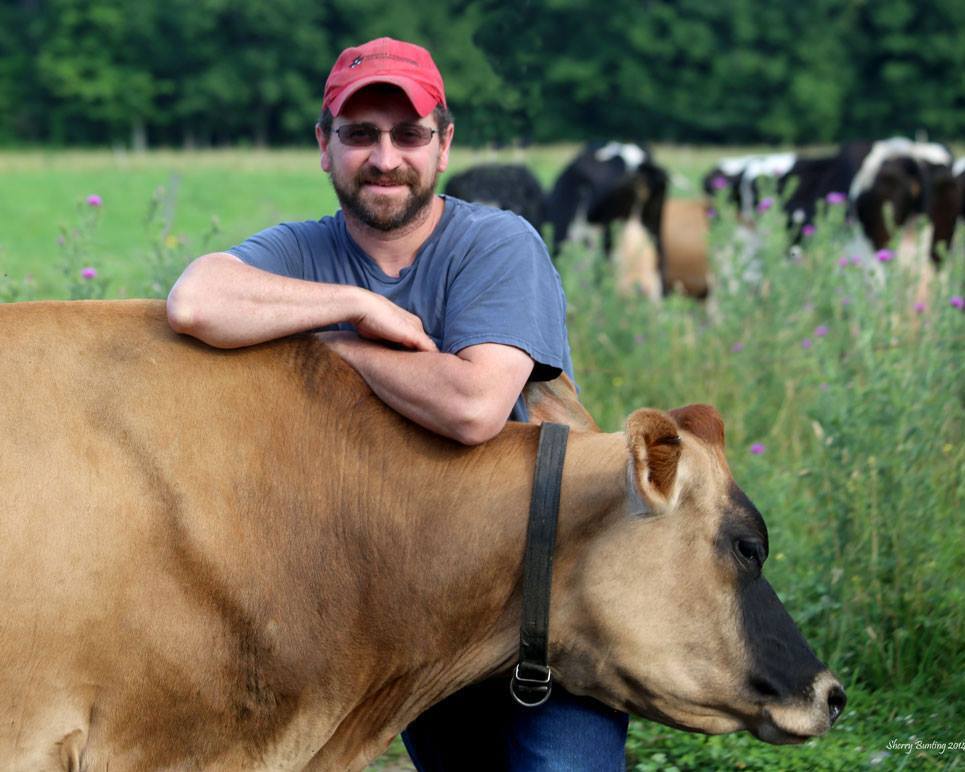
WEST WINFIELD, N.Y. —Dale Covert has been dairying since age 19. Growing up on a farm in Wyoming County, New York, raising heifers and veal calves on cows, he started his own dairy, fresh out of college. He rented two different farms in western New York, before moving to central New York in 1991 and landing in 1994 on the farm where he and wife Laura live and work today near West Winfield, in the Adirondack foothills of Herkimer County.
What’s special about Covert Dairy isn’t just its longevity or diversity—but its five homebred generations, still active on the farmfrom one of three branches of their Paigebrook Jerseys “bird” family. On June 15, that branch, and others, saw their scores raised, and a second heifer calf was born into the fifth generation.

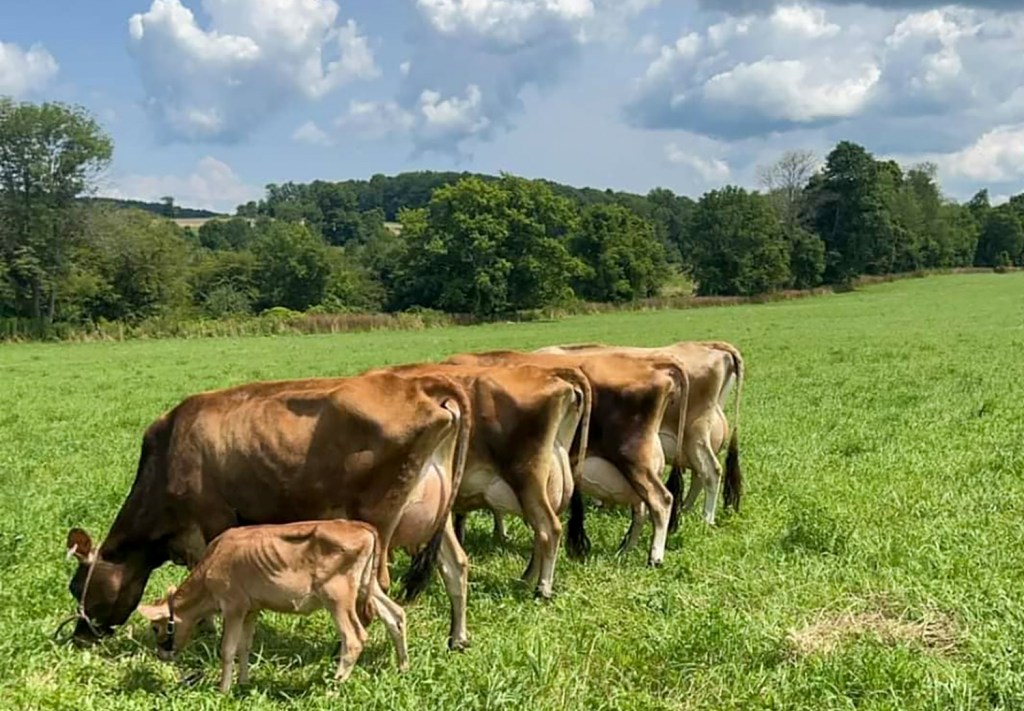
The line begins with Paigebrook Cool Scarlet EX-90, followed by her daughter Paigebrook Oliver P Finch EX-92, then Paigebrook Megapower Lovebird EX-91, then Paigebrook Gouda Flamingo VG-88, and now Flamingo’s first and second daughters: Paigebrook Saber Penguin, pictured as a calf in 2024, now a yearling, and Heron (by Stellar) born to Flamingo in June 2025.
Of the total 24 milking Paigebrook Jerseys, seven are scored Excellent, six are VG 85 to 88 points, and 11 are VG 81 to 84 points.
For Dale, it’s a dream realized of “all the pieces coming together.” He credits the aAa Weeks Animal Analysis system and bulls from Triple-Hil and Select for the herd’s genetic progress.
As a ‘Holstein guy’ and former National Holstein Distinguished Junior Member back in 1987, he’s also proud of the 23 Holsteins in his herd.
Dale started with Holsteins under the DALCO prefix and achieved a rare milestone: breeding four consecutive generations in a direct maternal line, each with over 200,000 pounds of lifetime milk.
Today, the Jerseys (24 milking) have surpassed the Holsteins (23 milking) in this 65-cow herd that also includes one each Brown Swiss, Ayrshire, Guernsey, several Dutch Belts and Linebacks, and a couple Fleckvieh.
The Jerseys started when Dale’s daughter Paige was in 4-H. “She wanted Jerseys, and so, of course dad bought her Jerseys,” he laughs. “Just like my 4-H herd got out of hand 40 years ago with Holsteins, hers did with Jerseys.”
Paige now has a career off the farm, and Dale purchased her interest in the Jerseys before she got married, including the bird family that began with a heifer named Squab, who was purchased as a 2-year-old.

“All the Jersey ‘birds’ descend from Squab, who lived to 13 and scored VG-88 with 182,000 pounds of lifetime milk,” Dale says. “She gave us six heifer calves, and many of her descendants have made over 100,000 pounds lifetime.”
Interestingly, when he bought Squab, the only thing he knew was she was sired by Solomon. He was able to do a bracket-one provisional registry, and the rest is history, seven and eight generations later.
The bird family has three branches. One is solid, another includes the five generations on the farm, and the third features Paigebrook Texas Hawk EX-93, her daughter Paigebrook Oliver P Owl EX-91, and Owl’s daughters and sisters—adding depth to this prolific lineage.
Scarlet, a granddaughter of Squab and matriarch of that five-generation set, is the oldest Jersey on the farm. At 9.5 years old, she’s due to calve in late August.
On the Holstein side, Dale’s Darla-Deidra-Dina-Denise line is also legendary as the four consecutive generations of 200,000-pound lifetime producers have fifth to seventh generations still in the barn today. Denise’s daughter Daisy and her descendants Dorothy and Dazzle continue to build on this legacy.
Delilah, 11, is the oldest Holstein in the herd today from the D-family and she has lifetime production over 130,000 pounds of milk at 5% fat and 3.6% protein. “She tests like a Jersey and looks like a Holstein,” Dale observes.
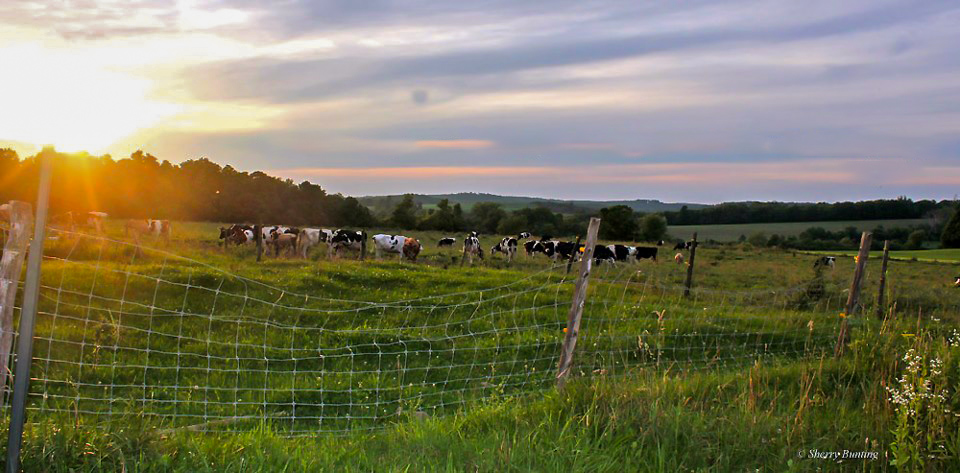
In fact, the grazing-oriented herd produces plant-run tests of 4.2 to 4.3% fat and 3.3 to 3.4% protein. Holsteins average around 18,000M 4.0F 3.3P milk, Jerseys 15,000M 4.7F 3.6P, and the remaining breeds 14,000M 4.2F 3.5P.
“I haven’t scored the Holsteins in a while, but I’m happy with their performance,” he says.
With stall space tight, Dale may soon have to think about marketing some of those prolific Jerseys from the pedigrees he has built.
Balanced breeding
Breeding at Covert Dairy is guided by the aAa Weeks Animal Analysis system, which he uses in combination with bulls from Triple Hil Sires and Select Sires.
“I want consistently productive cows that stay in the herd for a long time,” he explains. “If cows are productive at 8 to 12 years old, we don’t need as many heifers.”
His analyzer, Mike McCaffrey, adjusts evaluations for each breed. Though Dale had studied animal analysis in college and always looked at the numbers, he admits, “I was doing it wrong.”
A visit from aAa analyzer Dale Button years ago, changed that.
“I bought the Philip Hasheider book on balanced mating and read it cover to cover. With extremes, you get cows that are too tall or too dairy, or too-whatever you’re chasing. The aAa system brings you back to the middle, so you can make progress without losing that balance,” Dale Covert reflects.
Asked about genomics, he doesn’t mince words: “It means nothing to me.” While he finds A2 and polled gene data useful, he says index bulls “didn’t work out.”
Over the past 15 years, Dale has used mostly A2 and polled sires. Today, more than half the herd is polled—especially the Jerseys and many Holsteins. “I stink at dehorning,” he admits. “Now the vet does it, but thanks to polled genetics, there are only a couple to do.”
He remembers hearing John Burket speak at Empire Farm Days 15 years ago: “He said he used polled genetics and incorporated some non-polled genetics into that process — leaving just enough calves to dehorn to remind himself why.”
Dale appreciates Triple Hil’s approach in sire selection, especially how they align with the aAa system. “What makes Triple Hil unique is they don’t just list aAa numbers—they make it easy to find a 6-2-4 or whatever your cow needs. These are solid genetics from solid cows that fill your barn and fill your tank.”

Simplicity and longevity
“I’ve always followed the KISS method—Keep It Simple, Stupid,” Dale says. Still, he wishes he had understood the aAa system better, earlier. “When I started this dairy two weeks out of college, I was easily influenced. My start was the show ring, and I followed the fads.”
Now, he uses show bulls and production bulls more strategically: “The aAa system keeps me centered. I might want to use a flashy bull, but when a cow comes into heat, I check what she needs and what I have in the tank.”
Longevity in the herd fluctuates with the ebb and flow of generations moving through. Three years ago, 28% of the cows were past six lactations. Today, records show 14 of the 65 are in their 5th through 9th lactations.
The herd has been entirely homebred for years—except one recent Jersey calf purchase: a Chrome daughter out of a Valentino that didn’t make the cut for her previous owner. Now, she’s a milking 2-year-old and scored 83 points.
Using Udder Comfort over 15 years
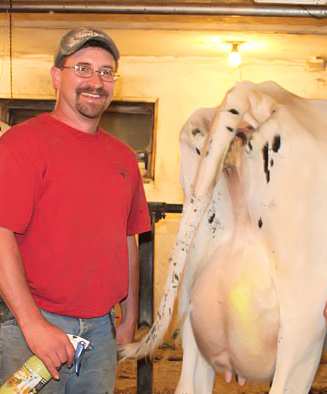
With a commitment to quality milk and comfortable, healthy cows, Dale also confirms he has used Udder Comfort faithfully since 2010. “I have continued using this product because I’ve tried them all and haven’t found anything else that works this well. It works fastest and is most effective,” he explains. “We use it on fresh and prefresh. We start spraying udders once a day for 10 days before calving. Our first calf heifers do so much better coming into milk with softer udders, and they are more comfortable. If we see any swelling or flakes, or a cow not milking out the way I like, we go to Udder Comfort.”
Why he loves dairying
What does Dale like most about dairying? “I don’t have to wear a tie,” he jokes. That was his goal during college mock interviews.
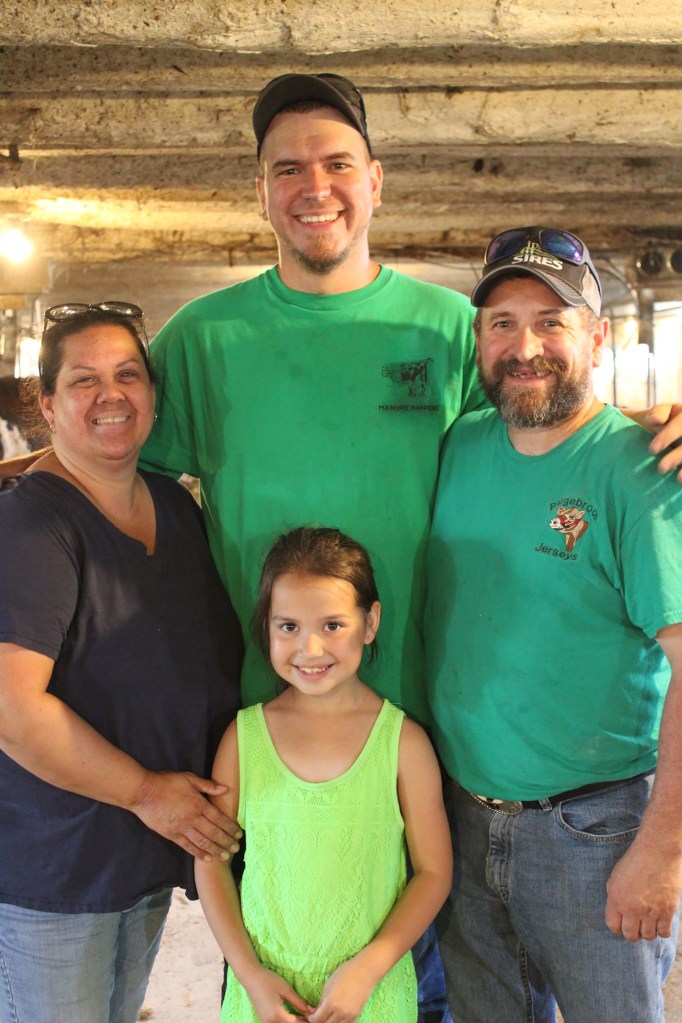
Laura says it’s the independence. He also enjoys working with young people—many who’ve worked at the farm say his mentorship and cows helped shape their adult lives.
Industry reflections
Like many dairymen, Dale has thoughts about the industry’s direction. He sees opportunity in New York State but worries about growing regulation, some of it internal.
He cites the FARM (Farmers Assuring Responsible Management) program as an example. “We don’t have a problem with it, but consumers don’t know what it is. They just want good food on shelves at a reasonable price,” he relates.
Dale likens the FARM program’s evolution to sitting on a beach as the tide rises. “At first the water tickles your toes, and it’s nice, it feels good; then it’s up to the chair, and suddenly your cooler floats away. Next thing, there’s a tsunami, and there’s no getting out.”
What started as an animal well-being model is now shifting focus to manure management and cropping practices, as though the industry wants to ‘regulate’ everything that happens on a dairy farm.
He sees a future where only two types of dairies may survive: the massive ones and the very small. The middle may become “too big to be small and too small to be big.”
Cooperation will be key, he says, and he’s already seeing farmers look at ways to work together to build scenarios that work for them to survive and thrive.
But at the end of the day, Dale Covert remains focused on what he loves (and he’s not alone): Milking cows he knows by their names, their families, their pedigrees, and their personalities, watching these cow families grow… and breeding balanced, productive animals that stick around for years.

 Profiles in comfort and quality