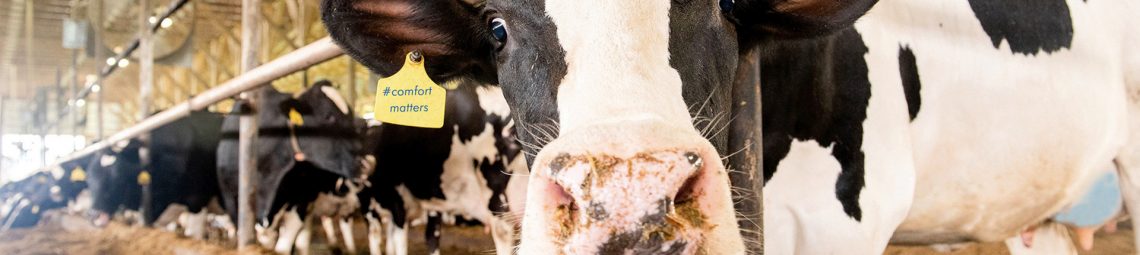

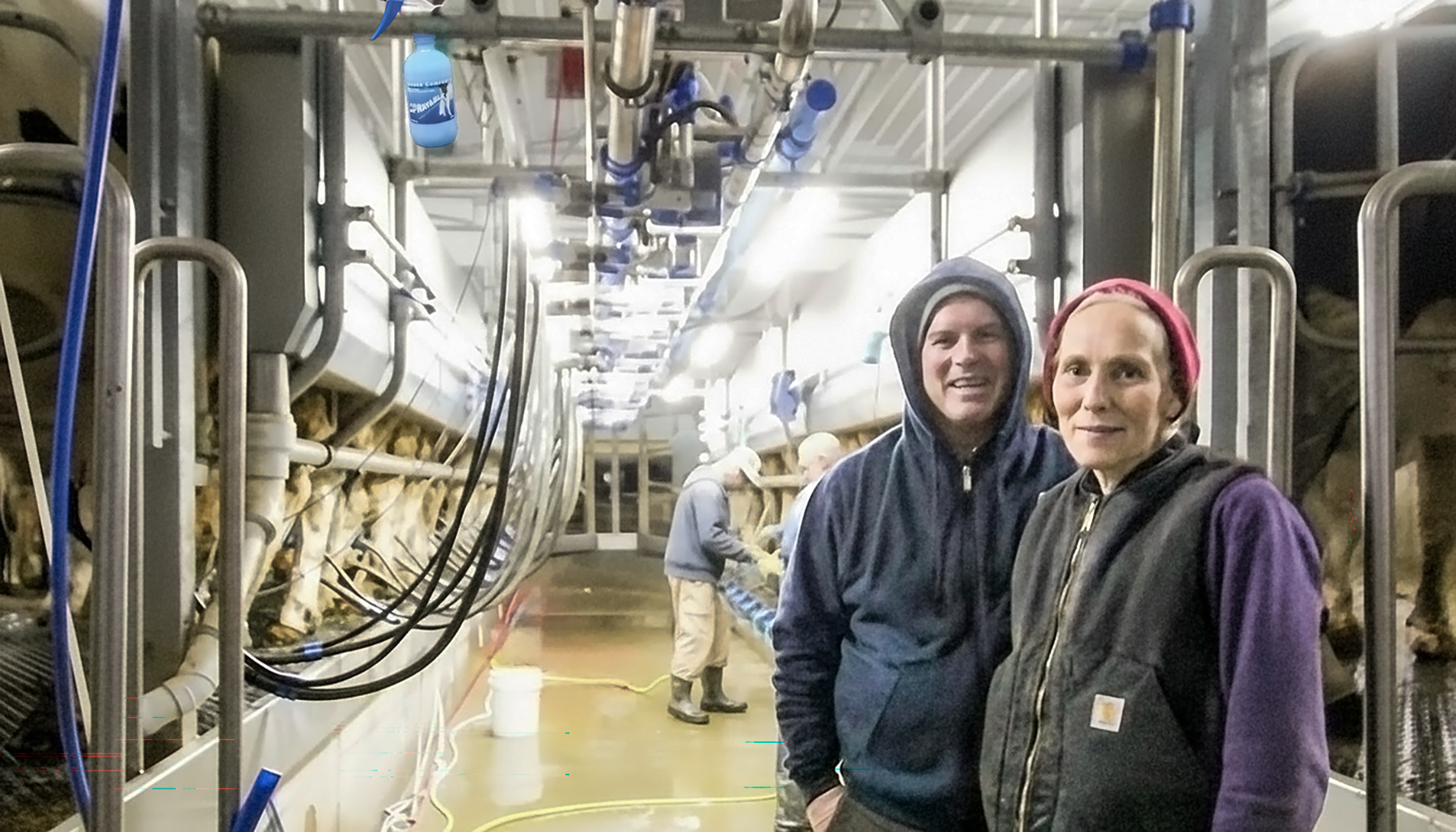
CASSVILLE, N.Y. — At Wormont Dairy in Oneida County, New York, fresh-cow management begins with a principle that Chuck and Vanessa Worden have followed for years: comfort drives performance.
“When a heifer prepares to calve for the first time, the udder swells and tightens with edema,” Chuck says. “As milk forms in the udder, along with this edema, the mammary system and the heifer become very uncomfortable. We want her relaxed for those first milkings, and afterward, so her udder stays in shape and the sphincter muscle works to close teats properly
to keep pathogens out.”
He explains that, “Udder Comfort does the job to relax the udder and improve the start.”
The available research also makes the case that udder edema can be costly, even when it’s not visibly obvious. The calving transition period is what dairy scientists describe as one of the most rapid biological transitions in animal agriculture.
This includes the transformation of the udder in the days surrounding calving as milk formation begins, circulation increases, and lymphatic drainage is taxed as the mammary system shifts from rest to full production. Even when swelling is not visually dramatic, udder edema can quietly affect comfort, milk letdown, teat closure, and early lactation performance — particularly in first-calf heifers.
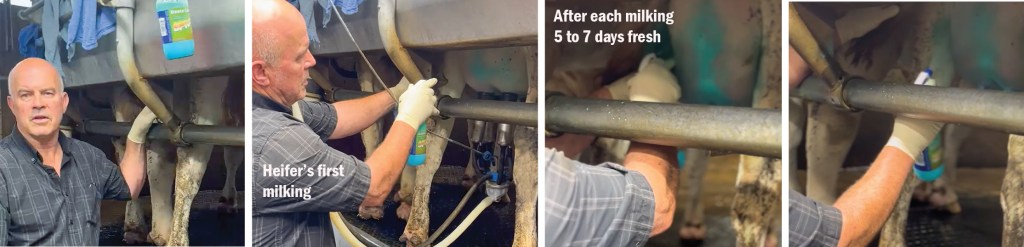
“When a heifer comes in for the very first time, she’s never been milked before, and she’s nervous,” Chuck says in his demonstration video. “We do everything we can to help her settle down and relax.”
That mindset shapes Wormont Dairy’s fresh-heifer protocol. After a normal pre-dip, wipe, and strip to confirm milk quality and that the heifer is four-quartered, the milking unit is applied.
“At her very first milkings, we spray a light application of Udder Comfort just above the rear teat cups. This relaxes the udder for a much better letdown,” Chuck explains. “The heifer feels the tingle of the product, which naturally encourages her to let her milk down.”
Chuck also makes sure all fresh animals get Udder Comfort after each milking for the first 5 to 7 days after calving, focusing on the udder floor from front to rear, the center seam, and the area between the udder and legs — the zones most affected by pressure, moisture, and friction.
“This helps reduce swelling, softening udders faster, and relaxing the sphincter muscle so the teat closes properly,” he says. “On the udder floor and center ligament, it softens to help the heifer maintain her udder shape. Alongside the udder and leg, the softening prevents the irritation and sores that tend to develop when a fresh heifer has a full udder and some edema.”
What Chuck has observed on his farm is increasingly backed by research.
A 2021 Journal of Dairy Science review led by Cora Okkema, working with animal-welfare scientist Temple Grandin, described udder edema as an “emerging animal-welfare issue” and noted that it is “quite costly” for dairy producers. The review explained that impaired lymphatic drainage and restricted circulation lead to inflamed tissue and tender teats, resulting in discomfort and behavioral changes such as reduced lying time and frequent stepping in the parlor. While udder edema itself is noninfectious, the authors noted it increases susceptibility to mastitis and udder cleft dermatitis (UCD).
Earlier research from the University of Minnesota and University of Illinois showed that more than 80% of first-calf heifers experience some degree of udder edema or UCD within the first 10 to 14 days after calving. That work quantified average losses of 316 pounds of milk per case of edema and 681 pounds per case of UCD in herds averaging about 72 pounds of milk per cow per day.
With today’s herd averages often reaching 90 to 100 pounds per day, those losses can escalate quickly. The more productive the herd, the more sensitive fresh animals become to even subtle swelling.
More recent work sharpens the focus on udder structure, swelling, and long-term skin health.
A 2025 University of Wisconsin–Madison study examining udder cleft dermatitis identified deeper udders, increased soiling, and lameness as key risk factors, highlighting how udder conformation and tissue stress during early lactation influence skin integrity and longevity. The researchers emphasized that swelling around calving — even when temporary — can alter how the udder hangs, increase moisture and friction in the udder cleft, and set the stage for dermatitis and secondary infections.
Those findings align closely with what Chuck sees in fresh heifers.
“When a fresh heifer has a full udder and some edema, that’s when we see irritation and sores start,” he says. “That’s why we focus on softening udders and taking stress off right away.”
Veterinary literature also continue to link edema with mastitis risk. Swollen tissue can stretch the teat sphincter muscle, delaying closure after milking and increasing the window of vulnerability for pathogens to enter the teat canal. Supporting faster normalization of the udder helps protect that natural barrier.
For Chuck, the takeaway is practical rather than academic.
“This isn’t just about appearance,” he says. “It’s about function. When cows get comfortable faster, everything works better. When edema removal is accelerated, fresh animals are free to perform. They get comfortable faster, settle in faster, milk better sooner, and get off to the kind of start that lets them reach their genetic potential.”
As herd production averages continue to climb, the margin for error during the fresh period narrows. The experience at Wormont Dairy — reinforced by both long-standing and recent research — underscores a consistent message: comfort drives performance, and softening udders early can shape how fresh heifers start, peak, and persist throughout their productive lives.
Udder Comfort has a booth at upcoming trade shows, including Pennsylvania Dairy Summit in Grantville, New York Farm Show in Syracuse, Central Plains Dairy Expo in Sioux Falls, and World Dairy Expo in Madison. Find Chuck Worden’s video, and other videos at www.youtube.com/@uddercomfort6 or visit www.uddercomfort.com and uddercomfort.blog to read more customer profiles.
 Profiles in comfort and quality